You finally know where your child is stuck.
54 topics, 270 levels, Kindergarten through Grade 6 — every question is generated on the spot, so the app never runs out. The Singapore method: build it, draw it, then write it. And all of it works offline, because the app does not hold the internet permission at all.
Buy once, keep forever · No subscription · No ads · No internet permission
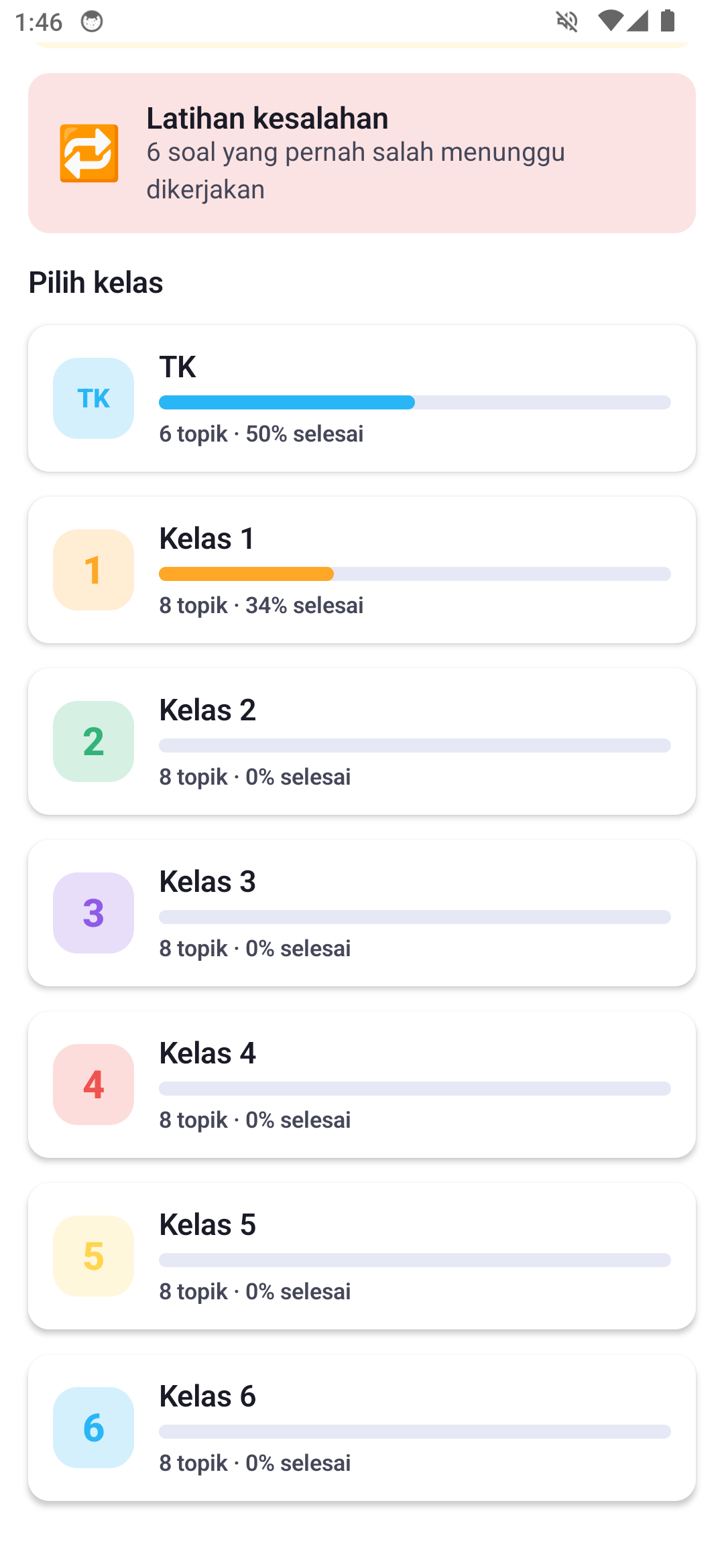
Seven year levels in one purchase
The report card says 65. It does not say which 65.
You know the mark went down. You do not know whether the trouble is fractions, or long multiplication, or whether your child understands all of it perfectly and simply keeps forgetting to carry a ten.
Homework becomes a fight. You explain it the way you were taught, your child was taught another way, and both of you end up frustrated.
Tutoring runs Rp 300–500 thousand a month, and what comes back is: "careless mistakes."
Three things that set it apart from an ordinary drill app
It is not about how many questions there are. It is about what happens when your child gets one wrong.
The questions never run out
Every question is generated at that moment, not drawn from a bank of 500 that a child eventually memorises. Replay the same level tomorrow and the numbers are different.
Mistakes do not evaporate
A wrong answer is recorded and brought back exactly as it was — not something similar, but that same question with the same numbers. It retires only after two correct answers, because getting it right once can be luck.
The mistake gets a name
Eleven error patterns are recognised and named, each with practice advice you can act on at the kitchen table. This is the part almost no other app has.
Build it, draw it, then write it
A child is not told to memorise 7 + 5. They build it with counters, draw it as a bar, and only then write it as a number. That order is what the Singapore method means — concrete, pictorial, abstract.
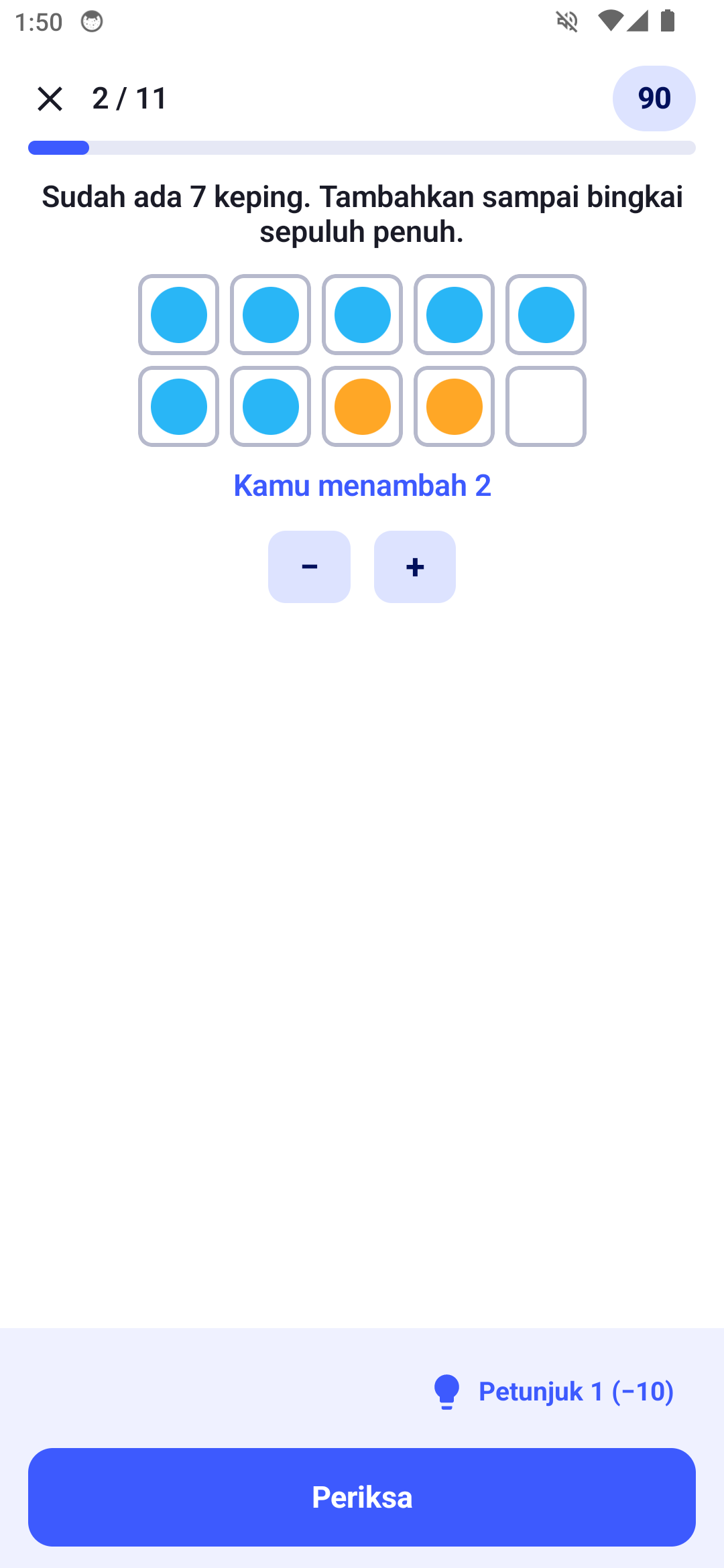
Concrete
Ten frames, base-ten blocks, fraction pieces. The child moves things they can see, rather than pressing digits.
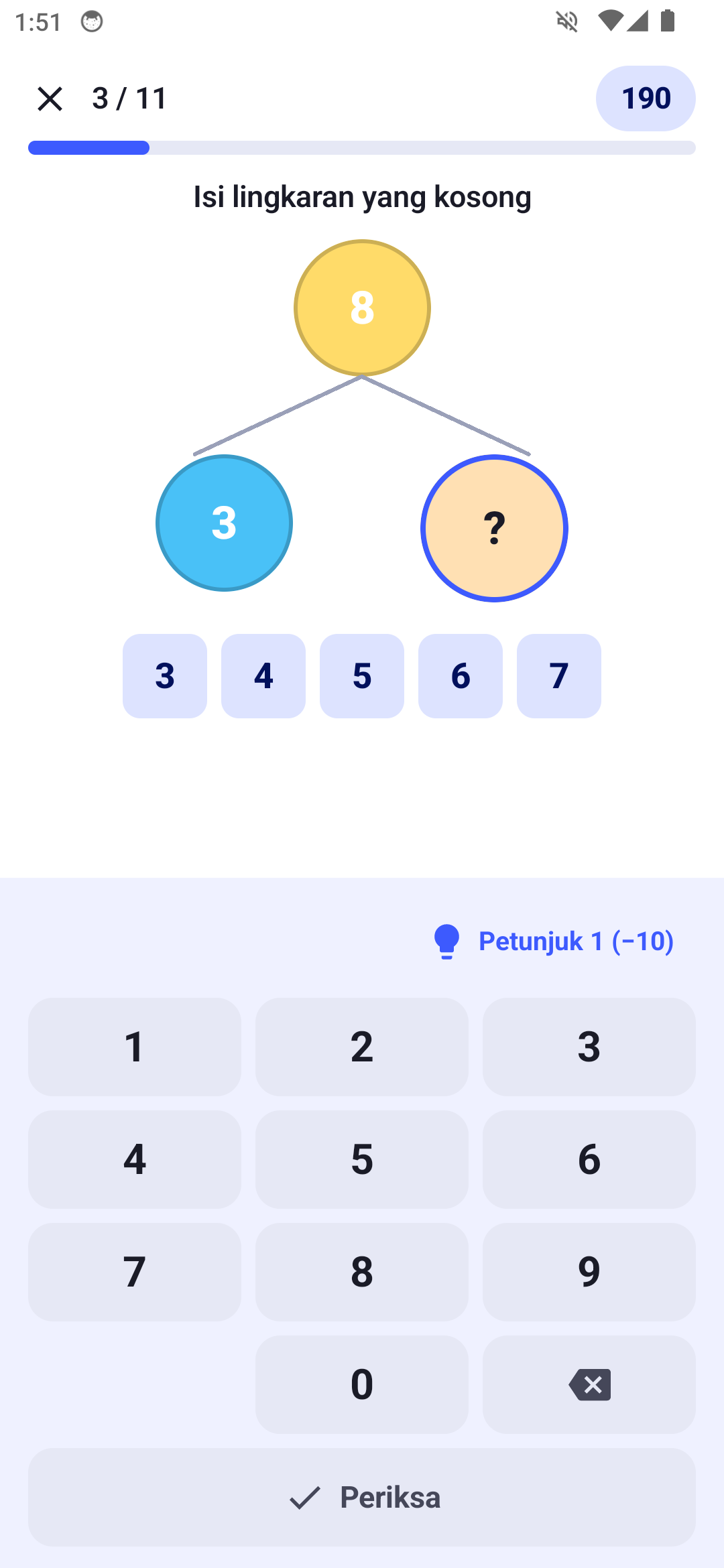
Pictorial
Number bonds and bar models. The shape of the problem becomes visible before any arithmetic happens.
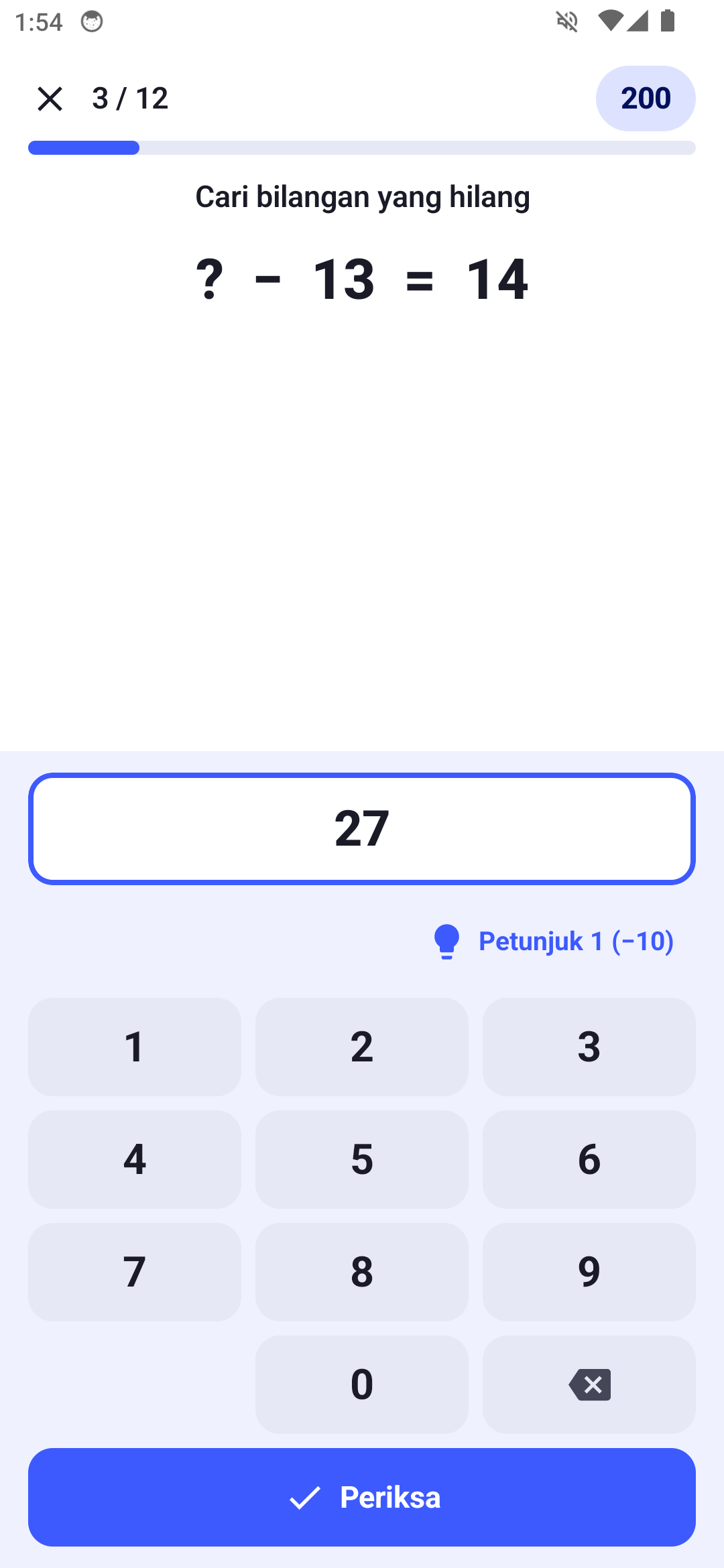
Abstract
Only here do the numbers stand alone: typed answers, multiple choice, ordering, matching, true or false.
And when a child taps "Show me how", the bar model is built one stage at a time in front of them — not shown already finished. Telling a child the answer teaches nothing; watching the bar assemble itself is the method.
54 topics, seven year levels, one purchase
5 levels per topic, 10 questions per level — 270 levels in all, every one of them included in the single purchase. Nothing is locked behind a second payment. Topics open in teaching order as your child works through them, and the two-minute placement check opens every year level below theirs at once.
- Number
- Operations
- Fractions
- Decimals
- Ratio
- Measurement
- Geometry
- Data
- Algebra
Kindergarten
6 topics · 30 levels · ages 4–6- Counting Things
- More or Fewer
- Ten Frame
- Patterns
- Longer or Shorter
- Putting Numbers in Order
Grade 1
8 topics · 40 levels- Numbers to 100
- Number Bonds
- Add and Subtract
- Make Ten
- Compare and Order
- Shapes and Patterns
- Length
- Telling Time
Grade 2
8 topics · 40 levels- Numbers to 1000
- Regrouping
- Multiplication
- Division
- Simple Fractions
- Money
- Mass and Volume
- Bar Model Basics
Grade 3
8 topics · 40 levels- Numbers to 10 000
- Times Tables
- Division with Remainder
- Equivalent Fractions
- Bar Model Problems
- Time and Duration
- Perimeter and Area
- Reading Graphs
Grade 4
8 topics · 40 levels- Rounding
- Factors and Multiples
- Long Multiplication
- Adding Fractions
- Decimals
- Angles
- Symmetry
- Two-step Bar Models
Grade 5
8 topics · 40 levels- Large Numbers
- Multiplying Fractions
- Decimal Operations
- Percentage
- Ratio
- Average
- Area and Volume
- Unit Conversion
Grade 6
8 topics · 40 levels- Algebra
- Dividing Fractions
- Percentage Change
- Ratio Problems
- Speed
- Circles
- Pie Charts
- Challenge Bar Models
The method and topic order follow the Singapore approach. Topics overlap broadly with most primary syllabuses, but the sequence and emphasis differ — that is deliberate.
Do not take our word for it. Check.
Every children's app claims to be safe. Only one thing separates them: whether you can verify the claim yourself in thirty seconds, without trusting anybody.
- Open Settings on your phone
- Go to Apps → Monstermath
- Tap Permissions and read the list
Permissions Monstermath requests
- Vibrate A short buzz on a right or wrong answer. Can be switched off in Settings.
- Notifications Requested only when a parent switches the daily reminder on — never on first launch.
Never requested
- ✕ Internet
- ✕ Camera
- ✕ Microphone
- ✕ Location
- ✕ Contacts
- ✕ Storage
- ✕ Installed apps
- ✕ Install apps
It adapts, without flattering you
An app that adjusts its own difficulty can easily become an app that praises itself. Every mechanism below exists to keep the numbers honest.
- A hint ladder — a nudge (−10), the strategy (−25), the first move (−45). The cost is shown before the button is pressed, so asking for help is a decision rather than a surrender button.
- Adaptive difficulty weighs up every three answers and adjusts inside the level — and never touches the stars. The stars keep meaning something.
- Spaced repetition — a three-star level returns after 7 days, a one- or two-star one after 3, then the gap doubles up to a 60-day cap. Failing it pulls it back to tomorrow. Mastered today is not the same as remembered next month.
- The placement test opens the year levels below without awarding stars that were never earned. What has not been done stays recorded as not done.
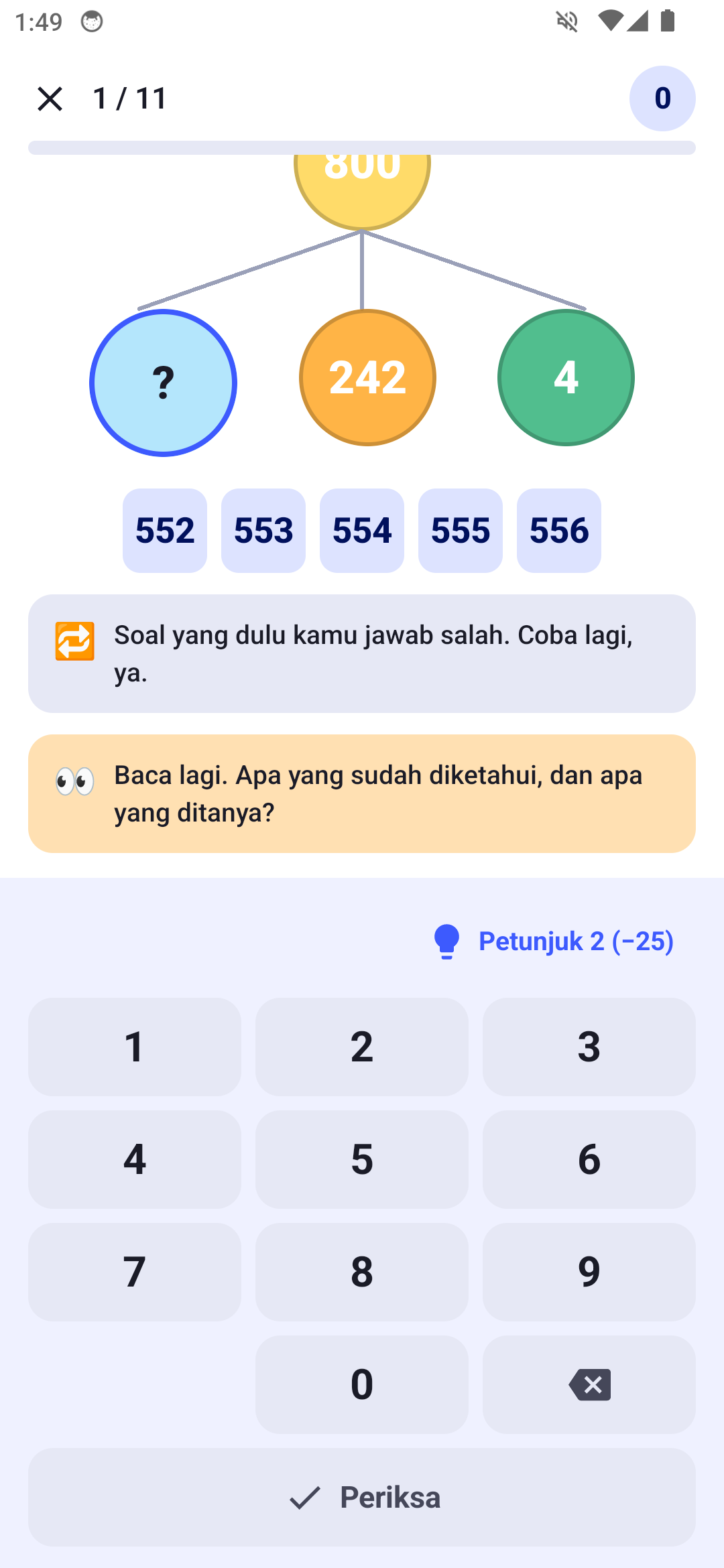
The price is written before you press
The part that is only for you
Settings, the report, and deleting a profile sit behind one two-digit multiplication. Not a PIN — a PIN can be forgotten, multiplication cannot. Answer once and it stays open for that session, then locks again next launch.
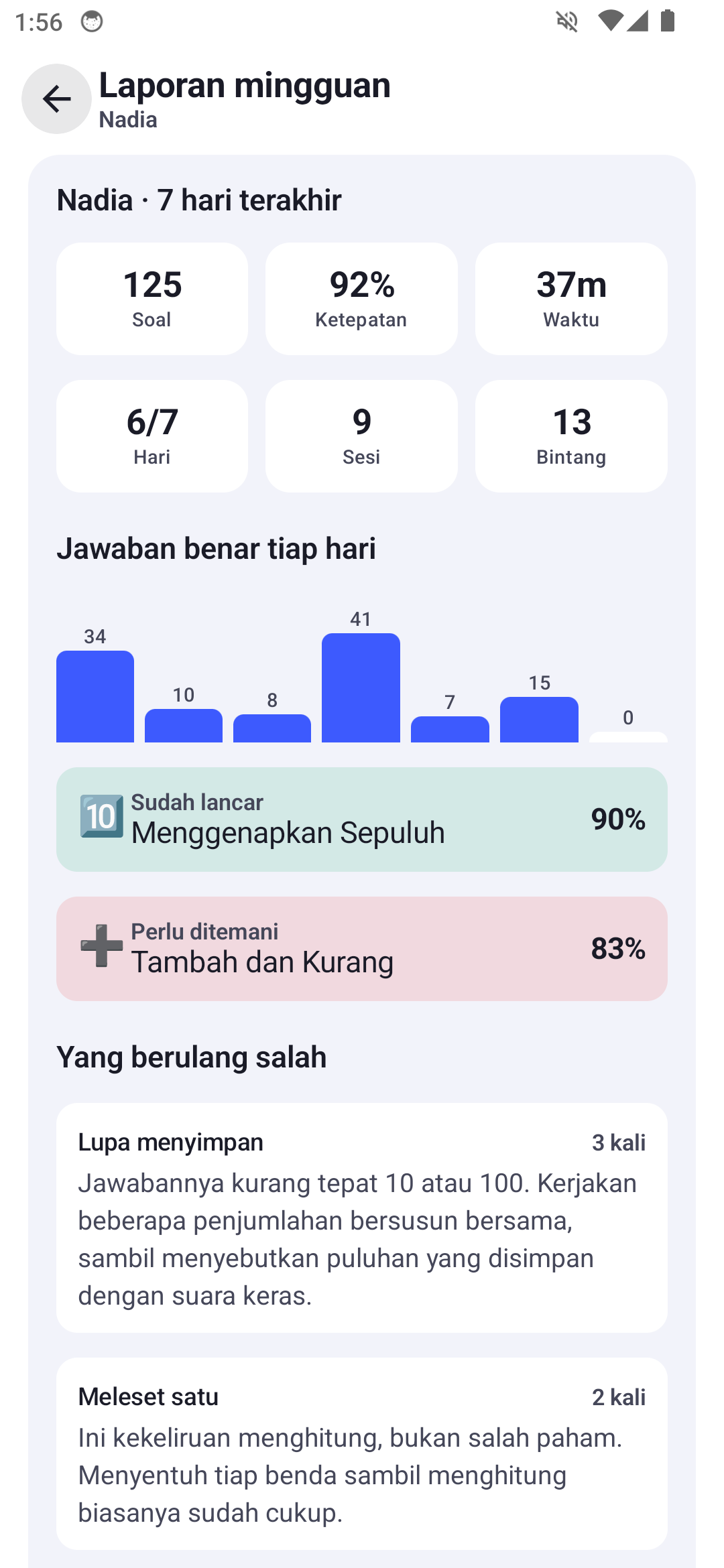
Seven days on one screen, shareable as an image
The weekly report
The last seven days at a glance: how many questions were answered, the accuracy, time spent, how many days were active, stars earned, a daily chart, and which topic is going well against which one needs a hand.
Shareable as an image — to a partner, to the class teacher, to the family group.
- Speed Sprint and Practise your mistakes are deliberately excluded from the topic ranking, so a mixed-question run cannot inflate one topic's score
- Multiple child profiles, each with its own progress and its own report
Not "careless." It is called forgetting to carry.
Every wrong answer is checked against a set of patterns. If it matches one of eleven recognised mistakes, it gets a name — and advice you can act on at home.
Forgetting to carry
The answer lands exactly 10 or 100 short. Work through a few sums in columns together, saying the carried ten out loud as it moves.
Numerator and denominator swapped
Say it as "three out of four" rather than "three four". The bottom number names the pieces; the top one counts them.
Units not converted
Answers in the unit that was given rather than the one asked for. Say the unit out loud with every number before starting.
Answering the part already given
The number in the question is being repeated back. Read the last sentence again together and underline what is actually being asked.
The other seven patterns it recognises:
- Forgetting to borrow
- Right digits, wrong size
- Decimal point one place out
- Counting the pieces left over
- Adding where it should subtract
- Doubling or halving the answer
- One out
A reason to come back tomorrow
This is not a layer of game on top of a boring lesson. Every piece is fitted so that it cannot contaminate the learning data.
Score and stars
100 points per correct answer, a speed bonus up to 50, a streak multiplier up to ×2 — and a wrong answer never subtracts points, it only breaks the streak. Stars: 1★ from 60% (which unlocks the next level), 2★ from 80%, 3★ for 100% inside the time allowance.
Ranks and badges
Eight ranks, from Beginner to Math Master, and 20 badges. The avatar shop uses coins = XP earned minus XP spent, so buying something can never take away a rank that was already earned.
Streaks and daily goal
A daily goal with a progress ring, and a reminder that skips itself when the goal is already met. A missed day can be covered by a saved freeze — one earned per seven days, two at most.
There is also a 60-second sprint, a leaderboard across profiles on the same device, and a two-player duel taken in turns — which is deliberately not saved, so a sibling's turns never enter the other child's statistics. All the audio is synthesised, with no sound files at all: an eight-bar background loop that can play for an hour behind a child without becoming irritating, and which can be switched off.
Three languages, and children who cannot read fluently yet
Indonesian · Sundanese · English
Switched inside the app; every question changes instantly. Inside the app all three are equals. We call the Sundanese beta here — Sundanese mathematical terminology is not standardised, and the translation is waiting on review by a native-speaking teacher. We would rather write that down than quietly hope nobody notices.
Read aloud
Questions are read out by the phone's own speech engine, with a button to repeat. If the device has no voice for the chosen language, the button is hidden and the reason is written in Settings — rather than left as a button that does nothing.
Readable by every pair of eyes
Three colour palettes, and more importantly: every bar segment carries its own pattern — diagonals, dots, crosses — so colour is never the only thing telling two things apart. The keypad digits grow with the system font size; the keys themselves size to the screen height.
An honest note: reading aloud helps, but from around Grade 2 word problems do require a child to read. This app is not a substitute for reading ability.
Three steps, once
Buy
You receive one licence key by email. It is long — around a hundred characters — because the signature travels inside it, so it is meant to be pasted rather than typed.
Install
Download the file from the link we send and open it. Android will ask you to allow installing from this source — normal for an app sold directly, and needed only once. Full guide here →
Activate
Paste the key once. No internet needed — not even for this step, because the signature is checked inside the phone. It works in aeroplane mode.
Pay once. Nothing after that.
One-time price
Rp 99,000
Rp 49,000
Save Rp 50,000- All 54 topics and 270 levels included
- Kindergarten to Grade 6 in one purchase
- Multiple child profiles
- Free updates, permanently
- No subscription, no ads, no in-app purchases
Payment is handled by lynk.id. The licence key is sent automatically once payment succeeds.
Roughly a quarter of one month of tutoring. Used for years.
Why not the Play Store?
Because this app is sold directly, with no store cut and no middleman. That is also what keeps the price down and why advertising was never needed.
The file you download is digitally signed, and we publish its SHA-256 fingerprint on this page. Before installing, you can check the file in your hands against the one we published — without having to trust us.
SHA-256 of the release file
96ec32ca 1aa6fb52 bc771a95 ac015fae 85dc4037 da389dff d4f47449 81fcfd65
Monstermath 1.0 · 9 August 2026 · how to check it is in the install guide.
Frequently asked questions
Does it need the internet?
My child is in Grade 4 but behind. Can they work below their year?
Do the questions run out if you replay a level?
Does it follow a particular national curriculum?
Does it replace a tutor?
How long should it be used each day?
How many child profiles can I create?
Will it run on an older phone?
Are the duel and leaderboard safe for children?
How good is the Sundanese?
What happens to my child's data?
What if it turns out not to suit us?
54 topics. 270 levels. Zero internet permission.
Stop guessing where your child is stuck. Start reading the name of what is going wrong.